

If you’ve ever spent time amongst writers, you’ve probably discussed whether you’re a “plotter” or a “pantser”.
I thought I knew exactly where I stood — until I didn’t…
If you don’t already know the shorthand:
Plotters plan.
Pantsers discover as they fly by the seat of their pants.
Or, to use a different metaphor: architects vs gardeners:
Architects design the building before laying a stone, while gardeners plant seeds and see what grows.
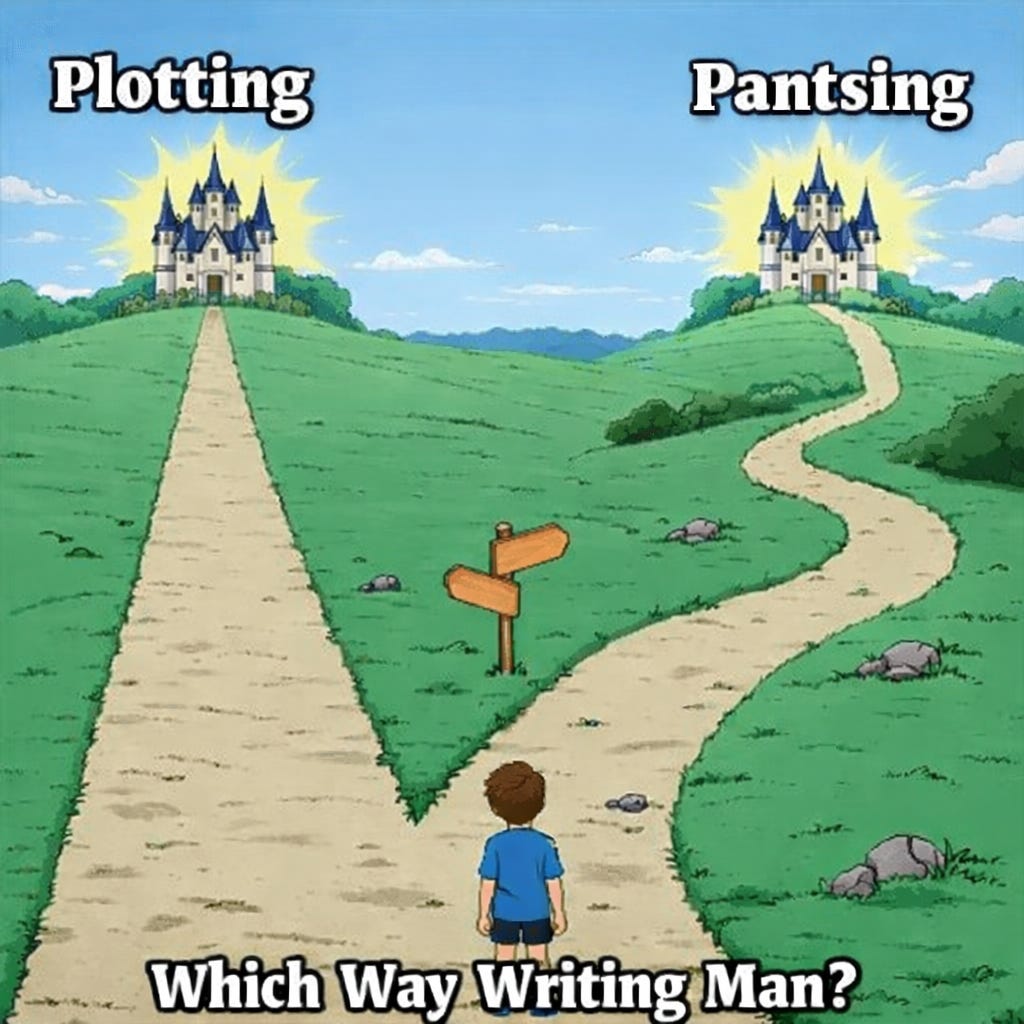
As with most traits, nobody is just one or the other. It’s a spectrum.
A writer will employ both approaches throughout their journey, and both lead eventually to the same destination, a completed story.
I’m a plotter. It’s built into my DNA.
The Chronicles of Heraldria is plotted to the extreme, designed the architect’s way, to the n’th degree.
It’s long-arc driven and structurally locked. Major events were decided years — in some cases decades — before they were written. Foreshadowing isn’t accidental. Payoffs are delayed on purpose. Changes ripple forward and backward in ways that make improvisation expensive.
Want to know what happens in the final scene of the last book? I could tell you, but I won’t (it’s not a JK Rowling bluff. If anyone wants to pay me one million dollars, I’ll forward it to you immediately after receipt of payment; the rest of you will have to wait).
Ask me what happened one thousand, two thousand years ago in Heraldria, I can tell you. There will eventually be an accompanying encyclopaedia for those who are interested (it’s already written).
Like I said, I’m a plotter.
Want appendices? Here you go.
Want maps? I have them.
Want family trees? I’d have to make them up, but they’ll fit the narrative.
I’m a plotter…
Most of the time.
Let’s say 75%
I’ve “pantsed” a few short stories, starting with a premise and letting it go from there. I’ve “pantsed” my way through whole chapters to link plotted waypoints in the narrative, and even full character arcs that annoyingly appeared to upset my careful plans (I’m looking at you, Forian).
What I’ve never done is “pantsed” a complete book.
Until now…
A fellow writer told me about Royal Road. For those who don’t know, Royal Road is a website where writers serialise their books (they publish chapters every so often, building to a novel that some then go on to publish).
He’d mentioned it before; he touted it as the new best thing for writers to air their wares, as it were. I’d looked into it and thought, “It’s pantsing. A chapter per week or more, and even I don’t know the end!? That’s not for me.”
(To be clear, Royal Road doesn’t force you to write this way — that was simply my assumption at the time.)
He told me that they were running a competition (I have a competitive streak, I’m not ashamed to admit).
The prompt was:
Dragons in Space!
Who doesn’t like dragons? Who does like anything, “In spaaace…”?
I decided to give it a go.
At first, it was anxiety-inducing. Writing without a fixed endpoint felt like stepping off solid ground. No master outline. No safety net. Just the next chapter, and the obligation to make it work.
The strange thing is that the mental process wasn’t as different as I’d expected. The same questions still surfaced: what does this scene do, what changes, what breaks, what carries forward? The difference wasn’t in the thinking, but in the timing. Decisions that would normally be made months or years in advance were being made in real time, under momentum rather than architecture.
There was more uncertainty, more risk — but also more immediacy. Discoveries happened on the page, not in notes. Some things surprised me precisely because they hadn’t been designed to.
And somewhere along the way, the anxiety eased.
I didn’t become a pantser. I didn’t abandon structure (I now have a whole other universe developing in my head). But I came to appreciate the craft of it — the discipline required to let a story grow without strangling it, and the trust it demands in both character and consequence.
Writing it feels fast, energetic, and occasionally reckless. The light only reaches as far as the next bend in the path, but that forward motion is intoxicating.
And there is no way back. What’s happened has happened. It’s already published, it’s out there in the wild, in the reader’s head.
I didn’t discover that one method was superior.
I discovered that both are honest, and both extract their price — just at different times.
Plotting front-loads the pain.
Pantsing defers it.
In both cases, you still have to earn the ending.
So the real question isn’t “Are you a plotter or a pantser?”
It’s this:
Do you stick to the path — knowing exactly where it leads, and ignore what else you might see along the way?
Or do you step off it, accepting that the spiders might get you?
If you’d like to compare the two approaches in practice:
The Chronicles of Heraldria — my epic military fantasy series — is on Amazon, unfolding according to plan.
Meanwhile, At the Tiamat Rift is unfolding live on Royal Road. A new chapter drops around the same time as this post. Give it a read and join me in guessing what happens next — because at this point, I’m discovering it too.
Comments are open here and on Royal Road, if you’re inclined.
I'm quite the pantser.
I was very interested to read this. Mostly because I am still intrigued by the process and where the heck the ideas come from. I am pantser, I always feel like a scribe, documenting the reel that starts playing in my mind. Bizarrely, it seems to work (most of the time!) but I usually don;t know where things are heading until we get there
.